Gravity Models
Constant Gravity Model
The simplest gravity model which combines gravitation and centrifugal accelerations. The standard unit of acceleration due to gravity (g) at the Earth's surface is 9.80665 m/s2, defined in SI units. The English approximation is often cited as 32.174 ft/s2. These values should be used as a constant for scenarios where it is indicated.
Inverse Square Gravitation
The simplest gravity model considered for the propagation of a space vehicle. The attractive force of two masses represents an equal and opposite attraction between the point masses. The magnitude is proportional to the product of the masses divided by the square of the distance, giving the "inverse square" nomenclature. For the purpose of simulating a vehicle mass (m2) in a gravitational well of a planet (m1), the simplification m1 >>> m2 results in a gravitational parameter (µ) equal to Gm1, where G is the universal gravitational constant.
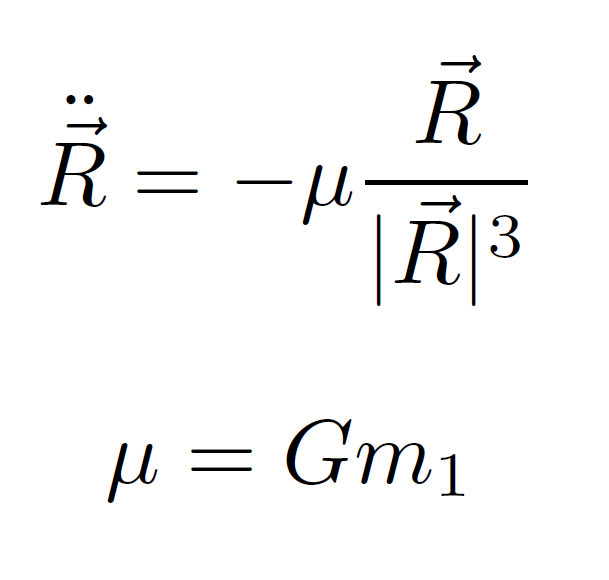
Where the vector R represents the position of m2 with respect to their common center of mass.
Spherical Harmonic Gravitation
The spherical harmonic gravity model takes into account geometric irregularities such as flattening at the poles of the Earth. For higher-order models, the spherical harmonic model captures localized differences in the Earth's density. The coordinates are typically planet-fixed with respect to the planetary body and are generally non-inertial. An important special case of the spherical harmonic gravity model is the J2 simplification which only includes the first two terms of the spherical harmonic expansion. This simplification results in gravitational potential that varies only with latitude and radius from the Earth's center when using only the first non-zero harmonic term for an oblate spheroid.
For more complex models, a higher-order harmonic can be implemented but requires greater computational resources. The higher-order harmonics used in select scenarios are the 4x4 and 8x8 gravity models. These have higher-fidelity modeling of mass concentration within the celestial body to simulate regional gravity field variations.
More details are given in the report on relevant equations for this gravity model.